
Whenever things went really wrong for me or my sister in our twenties, we would stay up late talking with a glass of red wine, passing a cigarette between us. Or we’d get tucked up in bed together with a slice of cake and cups of tea.
“You’ve got cake on your tits,” she would say. And I, the messy younger sister, would do my best to “clean up” her enviably soft and enormously comforting surroundings.
When things really went wrong, the latter was the most likely state you’d find us in past midnight.
I wanted to party every weekend. I was nineteen years old, living on a sofa. I’d joined a band, and the lead singer chucked my CV on top of everyone else’s at the restaurant she worked at (“They just hire whoever is on the top of the pile,” she told me — my first insight into kitchen hiring). The 2008 recession had hit, I was out of the job, and I remembered my extreme love affair with Nigella Lawson in the ’90s (albeit in my head) and was blindly led down dank corridors into hot oil and smoke.
I loved my food. I had always baked at home, paying no attention to quantities of sugar, butter, or cream. The more the better! Don’t you want to enjoy it?! Even if something made me feel sick, I didn’t throw up. Stomach of steel. Invincible!
Like everyone else, I definitely didn’t believe that illness would ever be a part of my life. How invincible you feel when you are well. You don’t realise that beautiful feeling of normal we all have — until it’s gone.
And I do miss it.
With cancer, so many people tell you how you feel. No matter their good intentions, it leaves you sitting silent. They speak about “adjustment” or “management” and “new normal” with chronic disease.
But who would want to adjust to it? Get used to it?
Your body and mind adjust as best they can, and it’s an incredible thing. But the truth is: your mind has to hope for something better. And so it should.
You just never think you might actually have cancer — not really. Not even if you find a worrying lump. You go to the doctor, you’re scared, you wait and see, and then you get the all-clear. Like any health scare.
But cancer is a funny thing. When you definitely have it… you know.
My tits told me first. They both hurt — rippling pain, all of a sudden.
I was taking a walk on a beautiful sunny day with my partner by the sea and should have felt happy, with worrying thoughts the furthest from my mind. But I knew.
So I checked later that day.
The lump was in the left breast, a couple of centimetres wide. Just floating there like a stranger in the bathtub.
I called it the “angry croissant” for weeks while I waited for my GP referral to the hospital to come through.
We had only recently moved to a new town on the coast, barely been there two weeks. I remember going for a walk alone and looking out to sea and quietly asking thin air if I had come here to die.
Perhaps I should have felt melodramatic, but instead, I felt calm.
Of course, I have not had my prognosis yet, and I am very much alive!
But I knew something was different at that time, like I was just waiting for confirmation of what my body had already confided.
I’m on my back and the oncologist says:
“If I was you, I would want to know. I would want to know… and it’s not good news.”
I’m on a couch, with the lead breast care nurse:
“You are doing so well. Most people throw up when they find out they have cancer… You CAN do this.”
Fast forward six weeks, and I have just done my first cycle of chemotherapy for breast cancer.
It was a tumultuous first week, getting used to various side effects, but I can honestly say that at times my fears and anxieties about many procedures were worse than the procedure itself.
Yes, there is so, so much to take on board — but you get through each bit at a time. Not all at once.
My mother told me, quite rightly: just play the next ten minutes.
I’ll be posting more about various things, but as a nurse once said to me: life can’t be all about cancer.
My treatment schedule allows a couple of days every two weeks where I feel more able to be active, so I get to play with new recipes and walk up a few hills.
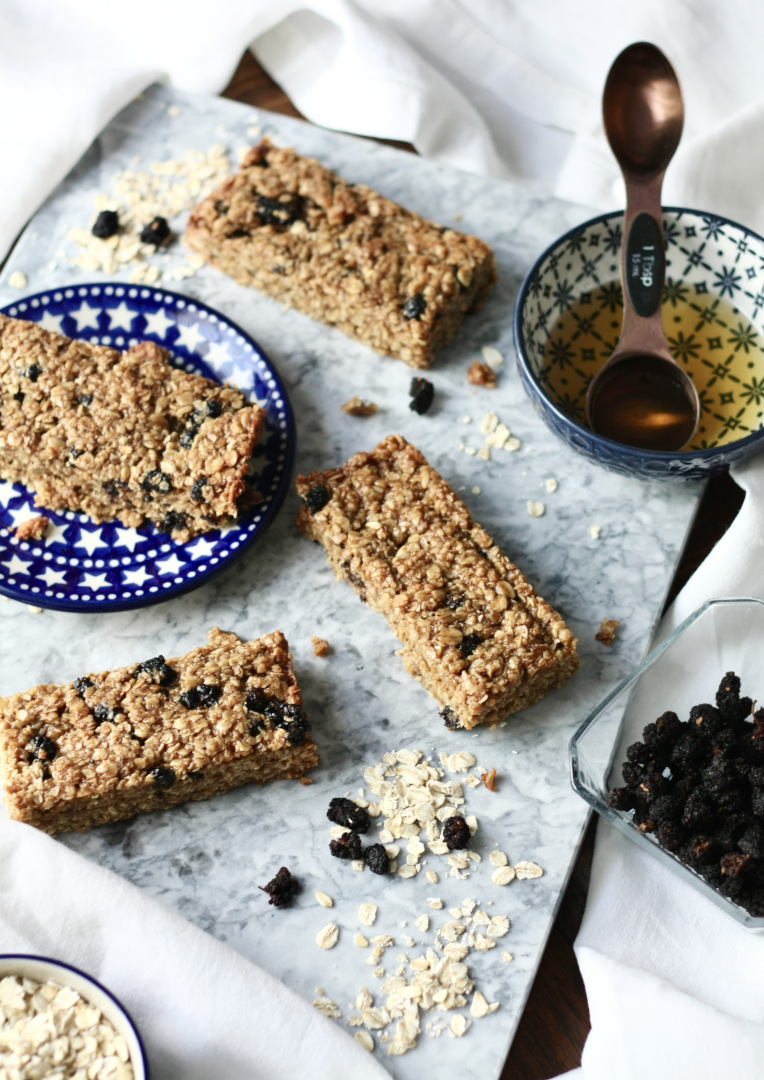
So here goes — the dark mulberry flapjacks recipe turned out so well recently. And my flapjack-mad partner is very happy that I can’t eat any of them!!
I learnt recently that all honey in the UK is unpasteurised (because there’s a minimum number of enzymes for it to be classed as honey), so I’m avoiding it during my treatment, despite it being heated to over 100°C…
I can’t wait to have a whole one once treatment is over.
Food choices are deeply personal on this journey, and no one else can tell you what feels right for you. The NHS doesn’t tell you what to eat or avoid — they encourage you to make those decisions for yourself.
So I give no advice to others — I only share my own creations and experiences.
I am personally more comfortable consuming coconut sugar than refined sugar, and even more comfortable using date sugar over coconut.
I think my dairy intake daily is important (I LOVE cheese — missing cheese and wine! Bring on Christmas…) but I leave dairy out of my recipes for the diabetics in my life who can’t have dairy or sugar.
Before my diagnosis, I’d spent quite some time in a rooftop flat above a farm, near a lake in the middle of nowhere, researching and recipe writing — and learning to temper chocolate. Chocolate is my first love, but I also wanted to develop indulgent bakes that could be intensely satisfying without any refined sugar, dairy or gluten.
I’m so happy to have finally perfected these flapjacks. When you are not using refined sugar or golden syrup, it takes time. I am proud of the balance between the ingredients; the type of honey used, the natural sweetness, the different densities that took some experimentation, resulting in a taste that made the flapjack connoisseurs in my life roll their eyes back in to their heads. When I can get these online and ready for home delivery, I’ll let you know — so get on the mailing list! And I hope to see you again soon x
 C A K E Y T I T S